Showing posts with label Craftsman press. Show all posts

Tuesday, June 8, 2010

Let the Printing Games Begin

Ahhh...the scent of printers' ink and press wash....nothing quite like it. The plates arrived and after checking them over, I cut them apart and started planning the printing. I decided to print the full page images first, and spent the rest of the afternoon cutting up paper. I found there was only just enough, as after ordering, I had decided to include an extra image. Oops! I shall have to be extra careful. 

The plates for the images have some larger solid printed areas which made adjustments necessary. My old table-top Craftsman press was built as a jobbing press, for printing small jobs such as tickets, and invitations. Because of its clamshell action, it is not ideally suited for printing large solid areas, not usually an issue for me. So for these images, I had to make several adjustments to rollers, ink and packing in order to get the solid black areas to print well. I then had to print with my full weight on the handle to get enough pressure. I printed dry on this handmade 30 gsm Japanese paper, as I didn't want to spoil the beautiful surface by dampening it. Anyway, the alterations worked. Looking at the handle of this press, which has been welded  at some time in its career, my guess is that I'm not the first to throw my full weight on it. I just hope it holds out.

The text printing went well, the damp paper gives a lovely crisp impression and again, as this was the Griffen Mill handmade paper I proceeded extra slowly and carefully. This paper has a watermark in the corner of each sheet, with the letters GM, the infinity sign (to indicate its archival status) and the initials MG for Mike Gibbs, the papermaker. I love the thought that I'm making a book with paper made by a real person, a person I have actually met, and that the paper could last for hundreds of years. I have a bible dating back to 1589, in the reign of Queen Elizabeth I. It is beautifully printed, the presswork is amazing and although it is pretty beaten up, still an object of my admiration for the skill that went into making the paper and printing it all those 400+ years ago.

Because the paper had been dampened I let it dry off a little and when it showed signs of curling, finished the drying process between blotters under a light weight.
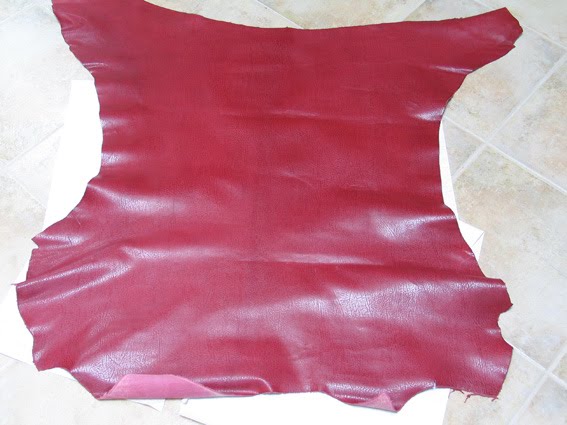
         
 During the time I was printing, my leather arrived! I had chosen it from a swatch on a card, so was not really surprised to find that it was slightly different in colour from what I had expected. One batch of leather never dyes the same as the next, it's a fact of life. This skin was a little brighter and redder than I expected, but still a very nice skin, as you can see. 


Monday, July 27, 2009

Paper Trail 1


So many types of paper, where to start? Usually with the sample books. Of course, the nature of the proposed book and the method of printing immediately narrow the field. This will be a handmade book, printed on an old hand-operated Craftsman iron press, and will be illustrated with hand-pulled prints, hand sewn and hand bound. During the years I worked on repairing and conserving books I learned a lot about which materials and book structures last. My aim is to make books that will endure the test of time. (I'm not saying I always achieve this, just that I aim to.)

Back to the paper, which has an important part to play here. These are the qualities I consider when choosing a text paper, in no special order:
  • Weight: for a miniature book, no more than 100 gsm. Ideally, for a codex style book I like the page to turn over and lie flat. This is almost impossible to achieve with a miniature, because of the page size. Compromises have to be made. With a larger heavier book, people often read them open on a table. With a miniature, they tend to be read with a hand each side of the book, the thumbs holding the pages each side, a more intimate reading experience.
  • Opacity: if you're printing on both sides of the paper, this is very important. Show-through, unless intentional, is usually ugly.
  • Colour: there is an infinite number of shades of white. The very bright white type of paper belongs with the computer printer. I tend to go for a soft white, sometimes called book white, unless I want to convey a particular character. For Qualicum Blue I used a pale blue paper.
  • Sizing: Size in this context means the dressing put into paper or onto the surface of paper to give it specific properties, e.g. strength, a smoother surface, less absorbency. A lightly sized paper suits my purpose.
  • Pressing treatment. A hard-rolled hot pressed paper is not suitable for letterpress, as it will not compress, and the ink lies on the surface of the paper. Paper that contains more air will compress during printing and give a more attractive appearance. Part of the charm of letterpress printing is that the letters are very slightly sunken into the paper, giving the page a 'sparkle' that you don't find with other printing methods.
  • Surface quality: it is important that the surface of the paper isn't too soft and woolly or it will pick up oil and sweat from readers' hands and become dirty quicker. Textured surfaces and inclusions (bits) interfere with small print and are best reserved for those books where the paper is the message, rather than the carrier of it.
  • Composition of the paper: some papers are made to archival quality standards, neutral pH, buffered, made to last and this is something I look for.
  • Papermaking method: handmade, mouldmade, machine made? Each has its strengths and weaknesses, to be explored in my next post.
Papers I've used for past books include Magnani book wove mould made (they make it in three different weights), Zerkall Ingres, Zerkall printmaking paper, Griffen Mill handmade papers, and for earlier books paper made from esparto grass (too soft), a Canson Ingres and a recycled paper called Retreeve, which was a mistake as it was too hard-rolled. I also used some real sheepskin parchment for one book - not strictly speaking paper, but its predecessor.

The photo shows some of my paper sample books. I test-print before I buy these days. In my next post I'll talk about what I eventually chose and why, and hope to have a guest on the blog.